

We’ve put together the 77 skates skateboard buying guide just in case you needed a little help choosing your new skateboard or skateboard components. If this doesn’t do it for you give us a call or message us. We’d love to help out.
DECKS
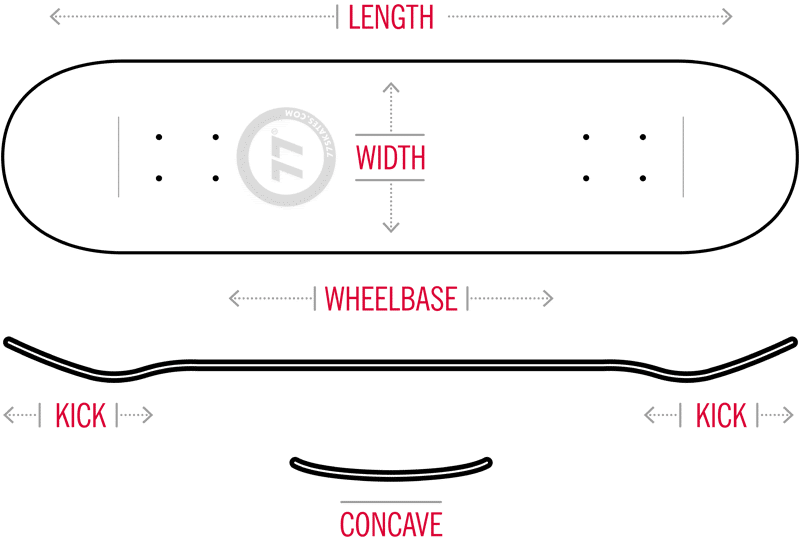
Decks come in various widths typically ranging from 7.5” to 8.5” although narrower decks of 7.3” or wider boards up to 10” are also available. Although you’ll be initially drawn to the sick graphics, choosing the right width is the most important factor when choosing you new deck. Too wide and you’ll be putting to much effort into your tricks, too narrow and stability becomes an issue. Your build and shoe size is also a factor. As a general rule;
7.5” to 8.125” is pretty much standard width for an adult skating streets or performing technical tricks
8.0” to 8.5” for skating, ramps, rails, skate-parks and pools
8.5”+ for vert, big bowls, jumping big gaps, going old-school or just cruising
but mostly it’s all down to personal preference.
WHEEL SIZE
Wheels come in a range of sizes with a diameter ranging from 49mm up to 60mm. Diameters over 60mm are mainly for cruisers and longboards.
49mm – 54mm are mainly used when skating street and tricks
53mm – 59mm for skate-parks, vert ramps, transition, and pools
60mm+ for longboards, cruisers and old-school decks

WHEEL SHAPE
There are a few things to concider when choosing wheel shapes. Namely the contact patch and the shape or profile. The contact patch (or riding surface) is the part of the wheel that touches the ground. This defines how much grip the wheel has. Narrower wheels are usually the go to for technical street skating because they slide easier for some tricks. Wider wheels are better for cruising and skating bowls as they maintain grip at faster speeds.
The profile or shape of the wheel’s edge can impact the grip, overall weight and how the wheel locks into grinds. Generally a more rounded edge will allow the wheel slide more easily. A sharper edge gives the wheel more grip and can help you lock into grinds without slipping out.
Standard/Classic
They have an ideal sized riding surface with rounded edges, making these a good all rounder whatever your preferred terrain.
Rounded/Radials
Radials have a slightly wider riding surface than a Classic which offers a bit more grip, making them a good choice for those who favour skating transition. They have a fuller round edge than a Classic for more control and a responsive slide.
Conical
On Conical shaped wheels, the corners are cut away and not rounded. giving you grip and slide when you need it. These are responsive wheels perfect for concrete parks where you need a little extra control.
Asymmetric/Lockins
Lock Ins have a wide riding surface. Their asymmetrical shape sees the outside edge shaped like a conical while the inside edge is cut straight.

WHEEL HARDNESS
Most wheels are measured using the Durometer A Scale. The higher the number the harder the wheel. Generally harder wheels are faster are used for smooth surfaces such as skate-parks. Softer wheels are slower and used for street or rough surfaces with the softest wheels being used for cruisers and longboards.
78a to 87a – Cruiser/Longboard
88a to 95a – Street skating and rough surfaces
96a to 99a – A Good all rounder, with good grip and speed. For skating street, skate-parks and smooth surfaces
101a – Hard and fast, Pro wheels

TRUCKS
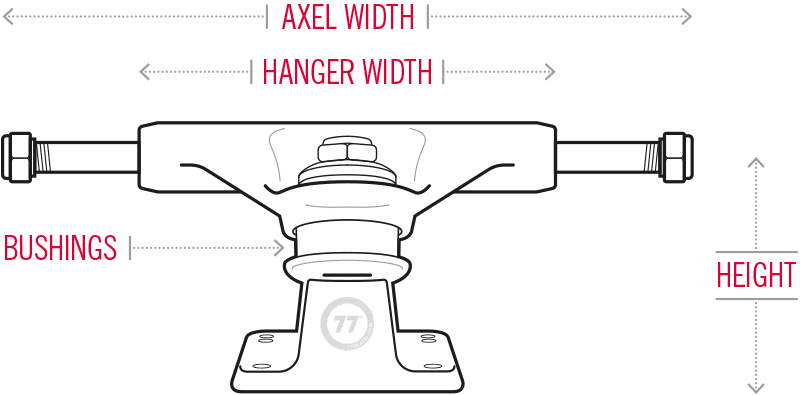
Trucks are measured by either axle width or hanger width. The height of truck is also a factor to consider when buying your trucks. The truck width affects your boards performance. A common setup is for the truck axle to be about the same width as the deck – this will offer the most stability. Trucks can be easily adjusted by tightening or loosening the kingpin (the bolt that goes through the centre of the truck). Loosen for tighter turns or tighten for stiffer turning. The bushings can also be changed for different riding styles (see Bushings below). A rough guide to which trucks you should choose for your board width is show below.
5.0, 129, 145 for deck size 7.5” to 7.8”
5.25, 139, 147 for deck size 7.8” to 8.2”
5.5/5.8, 148, 149 for deck size 8.5”+
RISER PADS
Risers are a thin hard rubber spacer that fits between the deck and truck increasing the overall ride high of the skateboard. These can be used if you choose a bigger wheel to stop the ‘Wheel Bite” this is where the wheel rubs on the underside of the deck during a turn or after landing a trick causing the board to come to an abrupt stop resulting in you face planting and damage to your deck. They can also be used to absorb some of the impact shock after landing tricks preserving your deck and reducing the risk of hardware vibrating loose.
BUSHINGS
Bushings are rubber elements mounted on the kingpin each side of the truck hanger. Like wheels Bushings are measured using the Durometer A Scale. The higher the number the harder the Bushing. Bushings should be chosen according to your size, weight and your riding style. Harder bushings are stiffer, making your board harder to turn and give you more stability. Softer bushings give you a looser ride, are easier to turn but give you less stability.
BEARINGS
Pretty much every bearing comes with an ABEC rating, these include 1, 3, 5, 7, and 9 A high grade bearing will generally be faster and last longer than a low grade. Its always better to buy the best bearings you can afford as they have a big impact on the performance of your board. Generally grade 5 is a standard for most skateboards and will give you a good bearing at a reasonable price.
BOLTS
Bolts are used to mount the trucks to the board they come in various lengths. You really only need to use longer bolts if you intend to use riser pads. You may want to use different coloured bolts to easily tell the nose and the tail of the board.